
Browse Items (19 total)
Lord Dunmore’s Proclamation, 1775
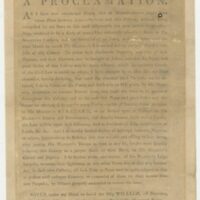
John Murray, fourth earl of Dunmore, was the last royal governor of Virginia. Assuming office in September 1771, he won support during what became known as Lord Dunmore’s War in 1774. Ostensibly to protect white settlers in the Ohio Valley region,…
Portrait of Black Hawk, 1833
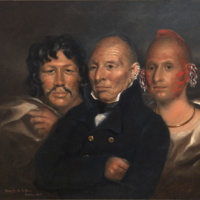
Black Hawk, born in 1767 and known in his native language as Makataimeshekiakiak, was a Sauk warrior and tribal leader. The Sauk lived on the Rock River, a tributary of the Mississippi, in what is now Illinois, and fought against the United States…
Petition of King William County Freeholders, 1843
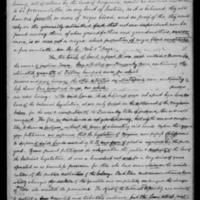
On January 20, 1843, a petition from residents of King William County was presented to the House of Delegates. The men who signed it asked the General Assembly to sell the lands that the royal government had set aside for the Pamunkey Indians by…
Pamunkey Indian Tribe, Counter Petition, 1843
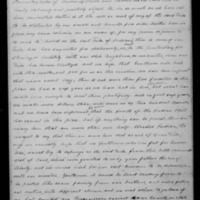
After a public notice appeared in a Richmond newspaper in October 1842 that a petition would be presented to the Virginia General Assembly to sell King William County property known as "Indian town lands," members of the Pamunkey tribe took action.…
Invitation to the formal opening of the Jamestown Tercentennial Exposition, 1907
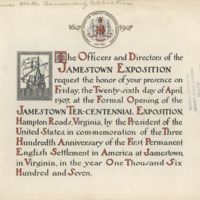
Late in the 19th century, some Virginians became interested in preserving historic buildings and landscapes that documented the state's illustrious past. White women led the effort to establish the Association for the Preservation of Virginia…
Virginia Health Bulletin: The New Virginia Law To Preserve Racial Integrity, March 1924
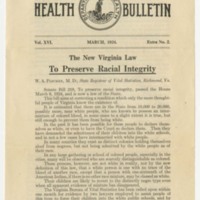
In 1924, Virginia's General Assembly passed the Racial Integrity Act, which was designed to stop the “intermixture” of white and Black people. The act banned interracial marriage by requiring marriage applicants to identify their race as "white,"…
Pamunkey Schoolhouse Photograph, May 31, 1937
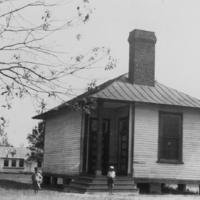
Indigenous peoples, including Virginia Indian tribes, were not considered American citizens even after ratification of the Fourteenth Amendment. They often faced discrimination and were denied the equal protection of the laws. Under segregation laws,…
Photo of the statue of Pocahontas at Jamestown, 1939, Virginia New York World's Fair Commission
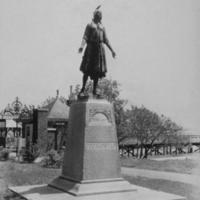
Touted as the largest and most magnificent exposition of all time, the New York World’s Fair opened at Flushing Meadows in April 1939. In the Court of States, one exhibition was strikingly different from the rest: the Virginia Room, “an island of…
Virginia Indian Tribes Pay Tribute Taxes to Governor Baliles, Photograph, 1989
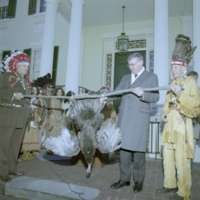
The annual payment of tribute by Virginia's Indians has been a long-standing practice that still occurs today. In 1646, Necotowance, "the King of the Indians" as the English referred to him, signed a treaty to end the third Anglo-Indian War. Annual…